
 Stephanie Joyce

A First-Time Voter’s, Independent Voter’s and “I Don’t Know What the F@ck Is Happening” U.S. Citizen’s Guide
So you got the primary ballot in the mail. It’s exciting for new voters, but there’s one problem. Well, a couple of problems. You don’t see your party on the return envelope. Like, somehow they forgot to send you the right “invite” or something. Did they?
For up-to-the-minute updates on the primary election, check out NBC’s excellent site that gives all the updates and state voting calendar here:
https://www.nbcnews.com/politics/2024-primary-elections/calendar
For the “On-the-Go” reader we summarized this article and divided it into 5 sections:
- Introduction to Primary Ballots: The article discusses the confusion faced by first-time and independent voters receiving primary ballots in the mail, highlighting the misconception that they must select a party for the general election.
- Overview of Primary Elections: The purpose of primary elections for first-time voters is explained, emphasizing that they are not obligated to choose a party for the general election during the primaries.
- Types of Primary Elections: Different types of primary elections, including open, closed, and semi-closed primaries, as well as partisan, nonpartisan, and all-party primaries, are outlined, with examples provided.
- Advocating for Non-Partisan System: The article advocates for adopting the non-partisan system used in local elections as a blueprint for partisan candidates in national politics, highlighting its benefits and encouraging reader engagement in debate and discussion.
- Challenges for Independent Voters: The challenges for independent voters in participating in primary elections, particularly in closed primary states, are discussed.
The call to action (CTA) is for readers to participate in surveys, provide feedback, and express interest in future articles on topics like the general election process and the “Forward” Third Party.
- Introduction to Primary Ballots
First-time voters may think it is their time to officially elect the party they will be choosing in the general election. They then feel compelled to select a Democratic or Republican candidate for president. Why? Well, you almost feel like this is what you are “supposed to do”. When I was eighteen, I sure thought it was at first. However, I never participated in the primary election because I learned quickly thereafter that you’re not obligated to re-select the candidates in the general election as the same candidates you selected in the primaries. I think of the primaries as a “dress rehearsal” if you will.
If you’re a Republican or Democrat, you may say when you get the ballot in the mail, “No biggie, my party is right here.” But if you’re not blue or red, then what? And if you want to change out of the blue and red, or “black” and “white” matrix completely, then what? Are you doomed to be “cattle-driven” to pick someone you don’t like? While it sure seems that way, and like I as stated in a different way in the paragraph above, the short answer is “No”. So any U.S. citizen, without a felony, can consider candidates from all parties and make their election based on their individual preferences, policies and qualifications.
For primary ballots automatically mailed to residents in open and closed primary provision states, there’s sometimes no option but “red” or “blue” candidates unless you request an independent or no-party ballot to be mailed to you. However, “no-party” sounds like “no fun”, doesn’t it? For example, in Arizona, a closed primaries state, to receive a ballot in the mail, “no-parties” or independents must contact the county recorder's office to specify the ballot type they wish to be sent to them. It is anything but an automated process (azcleanelections.gov).
Let’s say, for example, you’re an independent voter. As in “Declaration of INDEPENDENCE” voter. Depending what state you’re in, a closed primary provision could mean you don’t vote. The whole process is to let you practice filling-out a box as a “party pledge”.
- Overview of Primary Elections
Each state has different systems for primaries. There are open, closed and semi-closed primaries, as well as partisan, nonpartisan and all-party primaries. Every state’s system is outlined in its legislation. Washington, for example, uses open partisan primary systems.
Read more at: https://www.tri-cityherald.com/news/state/washington/article285859971.html#storylink=cpy
Here is a quick list of the open and closed primary states (for those curious like me):
| Closed Primary States: | Open Primary States: | |
| Alabama | Nevada | California |
| Alaska | New Jersey | Colorado |
| Arizona | New Mexico | Kansas |
| Connecticut | New York | Maine |
| Delaware | North Carolina | Massachusetts |
| Florida | Oklahoma | Minnesota |
| Georgia | Oregon | Montana |
| Hawaii | Pennsylvania | Nebraska |
| Idaho | Rhode Island | New Hampshire |
| Illinois | South Carolina | North Dakota |
| Indiana | Tennessee | Ohio |
| Kentucky | Texas | South Dakota |
| Louisiana | Virginia | Utah |
| Maryland | Wyoming | Vermont |
| Michigan | Washington | |
| Missouri | Wisconsin |
When independent voters receive a primary ballot, their options depend on the type of primary election system exists in their state:
Closed Primary States: In states with closed primary systems, independent voters typically cannot participate in primary elections for political parties unless the party specifically allows them to do so. Therefore, in a closed primary state, independent voters may receive a ballot that does not include options for voting in partisan primary races.
Open Primary States: In states with open primary systems, independent voters have more flexibility. They may receive a ballot that includes options for voting in either the Democratic or Republican primary, or they may receive a nonpartisan ballot if there are nonpartisan races or ballot measures on the primary ballot. In open primary states, independent voters can usually choose which party's primary to participate in without having to declare a party affiliation beforehand.
Semi-Closed Primary: A semi-closed primary is a combination of open and closed primaries which means registered voters affiliated with a particular party can only vote in their own party's primary, but unaffiliated voters (independents) may choose in which party's primary they wish to vote.
- Types of Primary Elections
Then we have partisan, nonpartisan, and all-party primaries. This is where is gets interesting and, as an independent vote, I do have a preference:
Partisan Primary: Voters choose candidates who will represent their party in the general election. This is the typical ballot you see in the mail as most states have this system.Candidates running for office are affiliated with political parties, such as Democratic, Republican, Libertarian, etc.
Nonpartisan Primary: In a nonpartisan primary, candidates do not run with a party affiliation. Nonpartisan primaries are often used for local elections, such as city council or school board positions, where political parties may not play a significant role. Voters choose from a list of candidates without regard to party affiliation. Could this be something that candidates running for larger offices adopt? It seems more cozy and personal.
All-Party Primary: An all-party, also known as a “top-two primary” system allows voters to choose from a list of candidates from all parties, regardless of the voter's party affiliation. This system is less common and combines elements of both partisan and nonpartisan primaries. The top candidates, regardless of party affiliation, may advance to the general election. The three, lonely states that have this option are California, Washington and Louisiana (for congressional elections only). I think for the national public servant positions, this makes the most sense.
I admit right now that I can go on a bit of a personal rant. But I don’t think I’m alone in all of the confusion on what primaries really mean. I think it is a type of mass brainwashing to get you to think you’ve already made your selection, somehow set in stone, before the general election. As always, what myself and the team writes in these articles is up for debate and discussion amongst university students nationwide.
- Advocating for Non-Partisan System:
Opinion: We need an update the primary and general election process to non-partisan (I have a good “why” too).
Here’s why I think we could incorporate the more localized non-partisan system to make presidential candidates more relevant in representing the people (and not just propagating unhinged emotional responses from good citizens simply reacting the “farce” that is this year’s elections). Here’s where I get more brainy. ChatGPT helped me shorten my explanation.
The non-partisan system in local elections offers several advantages over the partisan system. Firstly, it focuses on local issues, such as zoning regulations and infrastructure, which are more pragmatic and less ideologically driven. Something that all local communities are concerned about. Secondly, it builds on nonpartisan traditions, where voters prioritize candidates based on individual merits rather than party affiliation. And can we gather data to prove these candidates are upholding their promises year-over-year? In the age of AI, I think so.
Additionally, the non-partisan system promotes accessibility and accountability, allowing constituents to interact directly with candidates and fostering a sense of responsibility. Moreover, it prioritizes pragmatism over ideology, emphasizing practical solutions and collaboration across party lines. Lastly, it mitigates partisan polarization and emphasizes community service over political ambition.
Incorporating the non-partisan blueprint for partisan candidates could offer numerous benefits in national politics. By focusing on individual qualifications and community-centric solutions rather than rigid party lines, politicians could foster greater cooperation and effectiveness in addressing pressing issues. This approach could help bridge the gap between ideological divides and promote a more inclusive, responsive, and accountable form of governance at all levels of government.
- Challenges for Independent Voters
Due to a blatant disconnect between how communities vote locally with attention to servitude management verses nationally, which lacks servitude management; I’m left asking myself a question. Has the arguably out-dated primary and general election process, that leaves out so many “why” details, lead our nation to a shift in voter demographics?
Since I have personally surveyed hundreds of Americans for PulseDNA on issues ranging from third-party candidacy to “what makes credible news?”; the unifying message I’m getting is that people want to get involved and change things for the better in their communities. And they want more transparency. The fact that we don’t have the non-partisan model is what leading me to believe that we have a rise in independent voters.
Interesting Fact: Over one-third of the nation is not represented when these auto-mailed ballots come in the mail. This is the way it works in many, not all, states. It may seem like a little detail wether getting a ballot auto-mailed to you as Republican or Democrat; versus having to request it as an independent voter. But with the rampant rise of “decision fatigue” and all of life’s “to-dos,” do us independent voters have time to request a special ballot?
Well, I can speak as a lifetime independent voter myself. Like I mentioned in the beginning of this article, I never participated in the primaries. I always saw them as a popularity contest that displayed candidates most of America didn’t want, backed by the largest special interest spends, for years. I voted Ron Paul in 2012 and wrote-in Bernie Sanders in 2016. Heck, I even voted Libertarian and Green Party. Why? Because I can and because I don’t think exercising my right to vote, and showing-up to vote, is ever a wasted vote.
Here is a chart provided by a Gallop poll on the latest polled statistics on independent voters:
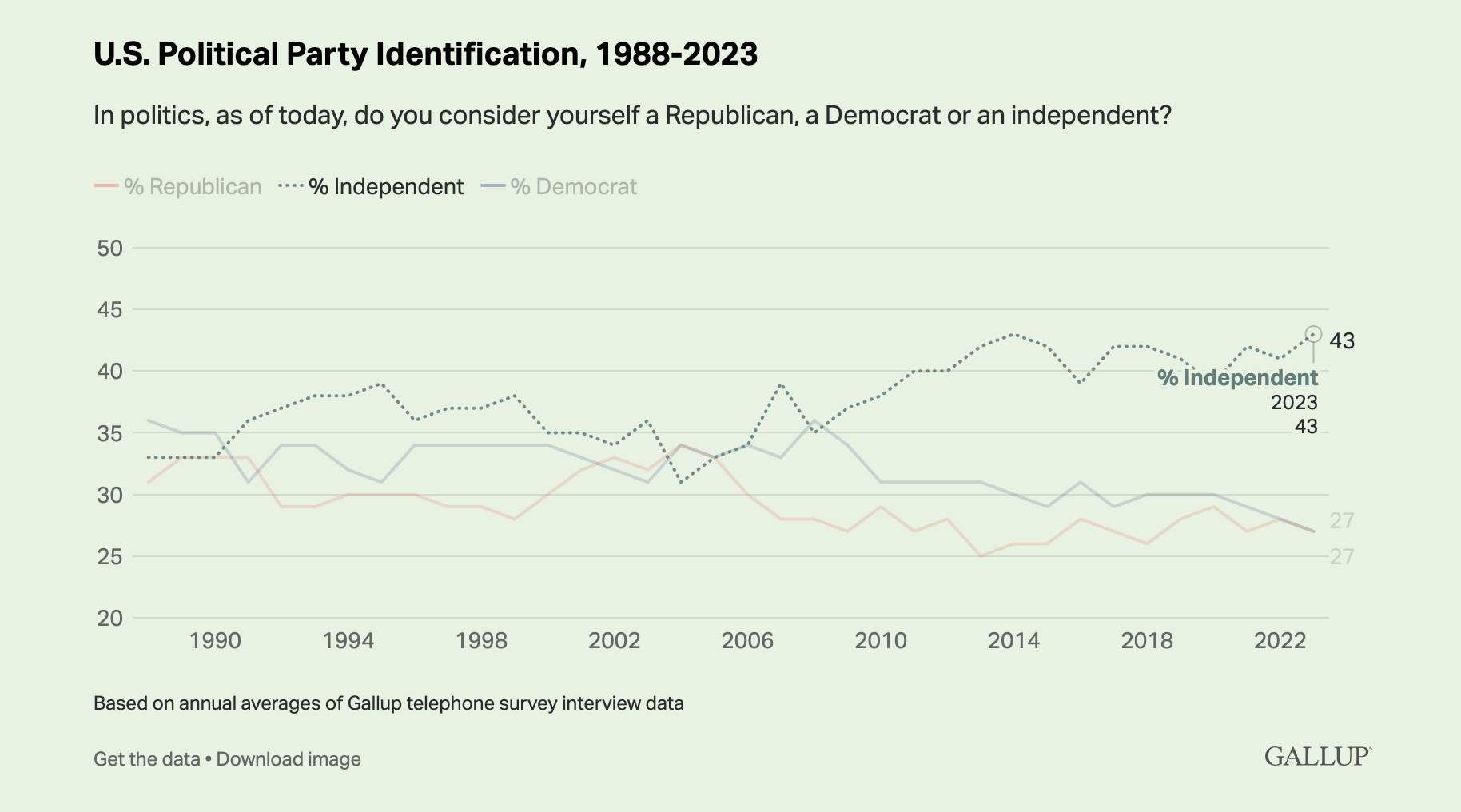
Hopefully this breaks things down enough for you to make an informed opinion. And if you already filled out the ballot, no problem. They are simply designed to get you to express loyalty to a party. Specifically Democrat or Republican. Kind of feels like programming, doesn’t it?
Let us know in the comments or survey if you would like an in-depth article around “General Election” process, sourced by AI and verified by our writer and editor team.
Your survey participation and comments will help us ensure broader reach to citizens and deeper understanding for future voting generations. I truly believe that we are all in this together if we are to help the world unf@ck itself.
We are also thinking about writing and article on the new “Forward” Third Party that was presented by Andrew Yang (Democrat) and Christine Todd Whitman (Republican), as reported by Reuters in a July 27, 2022 article. Let us know your thoughts.
Your Friend In Knowledge-Gathering,
Stephanie and The PulseDNA Team
################
We value your opinion! Please take a moment to share your thoughts by filling out our brief survey linked below this article.


GIPHY App Key not set. Please check settings